

Does Smart Home Technology Increase Property Value in the UK in 2026?

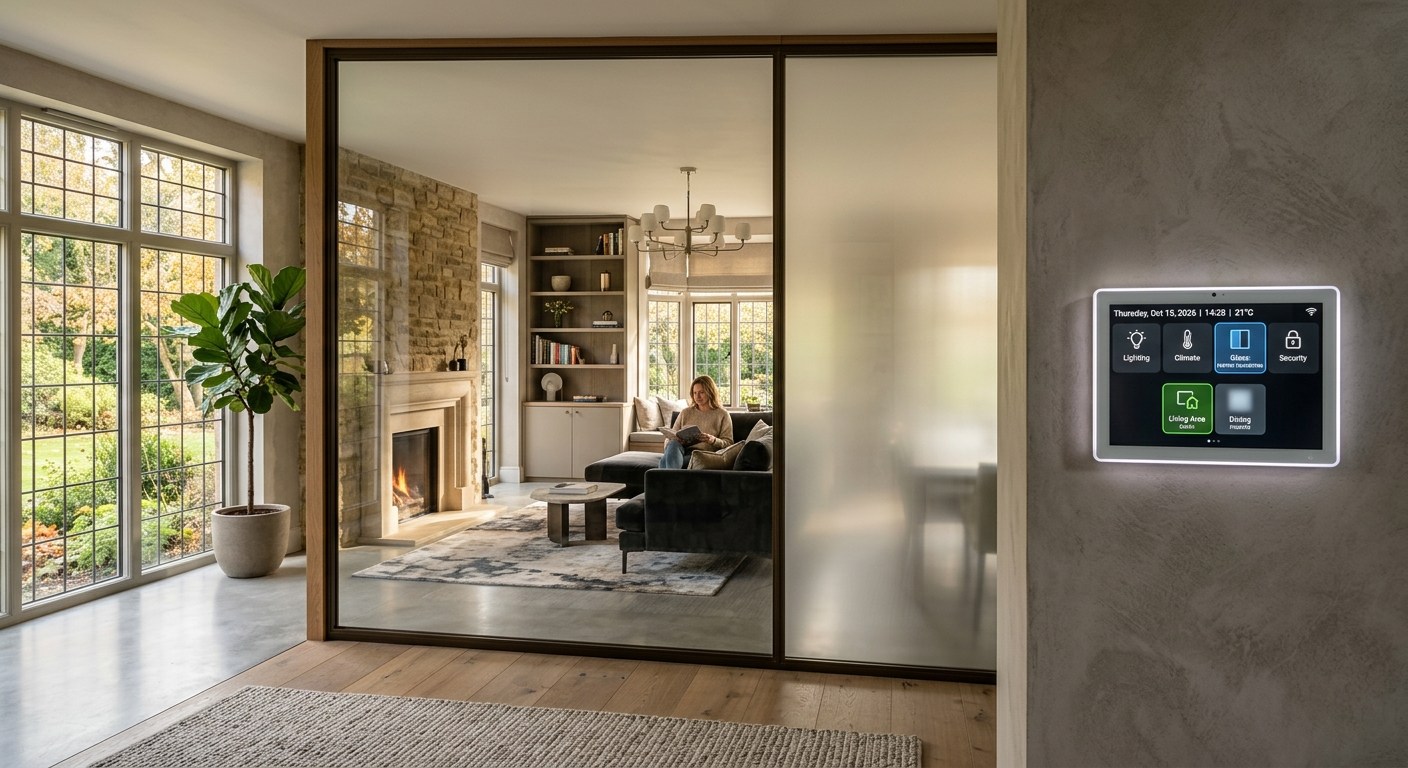
There is a question circulating in countless estate agent offices, property forums, and dinner table conversations right now:
Does smart home technology truly boost a property’s value, or is it still just a costly luxury for tech enthusiasts?
If you have been following the smart home value increase UK conversation over the past couple of years, you already know the answer is shifting fast — and in a direction that matters enormously for homeowners, developers, and anyone planning to sell or renovate a property.
This guide is not a surface-level overview. It pulls together market data, estate agent perspectives, energy performance evidence, real buyer behaviour, and a close look at the technologies that actually move the needle — including switchable smart glass, which occupies an increasingly interesting place in the premium property conversation. Whether you are a homeowner weighing up a renovation, an architect specifying materials for a luxury project, or simply curious about where the market is heading, what follows should give you a grounded, practical answer.
Table of Contents
KEY TAKEAWAYS
- UK buyers will pay an average 7.7% premium (≈£21,774) for a smart home — Samsung Smart Home Buyers Index 2024.
- 79% of people planning to move in the next five years want their next home to be a smart one.
- The UK smart home market is projected to reach USD 25 billion by 2030 at a CAGR of ~16.8%.
- Switchable smart glass (PDLC technology) is one of the few smart upgrades that simultaneously improves privacy, energy performance, aesthetics, and buyer perception.
- Smart glass can reduce energy consumption by up to 30% through IR blocking and optimised natural light use.
- Estate agents are actively highlighting smart tech features in listings — it is now a meaningful differentiator, not a novelty.
- Not all smart home upgrades offer equal ROI. The highest returns come from integrated, visible, and energy-linked technologies.
What the Data Actually Says About Smart Homes and Property Value in the UK
For years, the claim that smart homes add value was largely anecdotal — agents saying buyers liked the features, developers including them as a marketing tool, and homeowners hoping the investment would pay off at sale. Now there is substantive research behind it.
The Samsung Smart Home Buyers Index 2024
Samsung’s large-scale UK survey, released in mid-2024, is probably the most cited dataset in this space right now, and for good reason. It found that 79% of people currently planning to move home want their next property to be a smart one. More striking still, those respondents said they were willing to pay a premium of around 7.7% above the average UK house price for a home with smart technology already integrated. On the average UK house price of £282,776 at the time of publication, that translates to roughly £21,774 in additional willingness-to-pay.
That is not a marginal uplift. A 7.7% premium is comparable to, or larger than, many conventional home improvements that homeowners routinely spend significant money on — including some kitchen renovations, landscaping, and even garage conversions. The important distinction is that buyers are naming smart technology specifically as their motivation, not simply assuming it is bundled into a general quality premium.
Market Size Trajectory
The broader market context reinforces why this matters. The UK smart home market was estimated at approximately USD 9.74 billion in 2024 and is forecast to reach USD 10.84 billion in 2025, growing towards USD 25 billion by 2030. Household penetration — the proportion of UK homes with at least one smart device — is already projected at 87.8% in 2025, and expected to approach near-total coverage (98.4%) by 2029 according to Statista modelling. Over 60% of UK households reported owning at least one smart device by 2025.
What this means practically is that having some smart home features is rapidly becoming the norm rather than the exception. The question for property value is not whether buyers expect smart technology — increasingly, they do — but which technologies add the most perceivable, lasting value.
According to Samsung’s 2024 Smart Home Buyers Index, UK buyers are willing to pay an average premium of 7.7% (approximately £21,774 on the average UK house price) for a home with integrated smart technology. The UK smart home market is forecast to grow from USD 9.74 billion in 2024 to USD 25 billion by 2030.
How Estate Agents in the UK Now View Smart Technology
The estate agent’s perspective on smart home features has shifted noticeably over the past two to three years. What was once treated as a curiosity — worth mentioning but unlikely to affect the asking price — is now increasingly being treated as a genuine selling point, particularly in certain market segments.
Properties with smart features are now more likely to be marketed using that technology explicitly. Agents are highlighting smart heating systems, security cameras, app-controlled lighting, and motorised window systems in listings because they attract a different quality of enquiry. Buyers who are actively searching for connected homes tend to be motivated, financially capable, and often transact faster — partly because they have done their research.
The millennial and Gen Z buyer demographic is a key driver here. A significant portion of buyers who have entered the market over the past decade grew up in a world of smartphone-controlled everything, and they bring those expectations to property. For this cohort, the absence of smart infrastructure in a home can actually feel like a negative rather than a neutral factor.
What Agents Are Reporting
Agents are increasingly advising sellers to highlight the tech specifications of their homes in the same way they would highlight a new kitchen or a recently replaced boiler. That said, the most experienced agents are also clear-eyed about nuance: smart features tend to support value rather than single-handedly create it.
A badly maintained property with a smart thermostat is still a badly maintained property. But between two comparable properties, the one with smart integration is typically the easier sell and can support a higher asking price — particularly in competitive markets like London, the South East, and other major urban centres.
There is also a growing recognition that smart home features affect time on market. Properties with well-presented smart technology tend to generate stronger early interest, which matters enormously in a market where the first few weeks of listing carry disproportionate weight.
| ESTATE AGENT VIEW ON SMART TECH |
| Estate agents across the UK are now treating smart home features as a genuine value-add in listings — particularly systems that are already installed, integrated, and visually impressive to prospective buyers. The emphasis has shifted from novelty to infrastructure. |
Not All Smart Upgrades Are Equal — Understanding ROI by Technology Type
One of the most useful things anyone can do before investing in smart home technology for property value purposes is to understand that the ROI varies significantly by upgrade type. Some smart technologies add immediate, tangible value that buyers recognise and respond to. Others are genuinely useful to live with but contribute little to perceived property value at resale.
Here is a practical breakdown of where the value tends to sit:
| Technology | Value Impact | Notes |
| Smart heating | High | Energy bills, EPC rating, and buyer recognition |
| Smart security (cameras, video doorbells) | High | Strong buyer appeal, safety narrative |
| Smart lighting | Moderate | Appealing but often removed by sellers |
| Switchable smart glass | High to Very High | Permanent, visible, multi-functional, premium signal |
| EV charging point | High | Rapidly becoming a buyer expectation |
| Smart locks/access control | Moderate–High | Relevant in the urban/rental market |
| Smart appliances (fridges, ovens) | Low–Moderate | Rarely included in sale; perceived as movable |
| Motorised blinds/curtains | Moderate | Appealing in the luxury segment; limited mass appeal |
| Home automation hubs | High (luxury) | Strong premium signal in £500k+ market |
The technologies that consistently score highest for property value impact share a few common characteristics: they are permanent (built into the fabric of the property rather than removable), they are visually demonstrable during viewings, they have an energy or running cost benefit that buyers can calculate, and they signal something meaningful about the property’s overall quality level.
Switchable smart glass sits at an interesting intersection of several of these criteria, which is why it deserves extended attention in any honest discussion of smart home technology and property value.
Switchable Smart Glass: The Smart Home Upgrade Property Professionals Are Starting to Take Seriously
If you have not encountered switchable smart glass in a residential or commercial context, the concept is straightforward: it is glass that transitions from transparent to opaque — and back — at the touch of a switch, a tap on a smartphone screen, or a voice command. The technology has been used in high-end commercial environments, hospitals, and architectural showpieces for some time. What is changing now is its growing relevance in premium residential property, both as a new-build specification and as a retrofit upgrade.
The technology behind most switchable glass sold in the UK today is called PDLC — Polymer Dispersed Liquid Crystal. Understanding how it works helps make sense of why it performs the way it does.
How PDLC Technology Works
PDLC glass contains a layer of liquid crystal molecules dispersed within a polymer film. In the ‘off’ state — when no electrical current is flowing — those molecules are randomly scattered, causing incoming light to diffuse and the glass to appear opaque. When voltage is applied, the molecules align uniformly, allowing light to pass through cleanly and the glass to become transparent. The switch from one state to the other takes under a second.
This mechanism has several practical consequences that are worth understanding before evaluating the technology for a property project:
- Total visual privacy in the off state. You cannot see through the glass from either side. Diffused light still passes through (it is not a blackout), but there is no visual transmission.
- The on state (transparent) is genuinely clear. High-quality PDLC film can achieve haze levels below 3% and total light transmittance above 88% in the transparent state — meaning the glass behaves almost like standard clear glass when switched on.
- In the off state, the glass blocks 99% of UV radiation. This directly protects flooring, furniture, and artwork from fading — a tangible benefit that is rarely highlighted enough in property conversations.
- In the off state, the glass also blocks approximately 30% of infrared radiation, which reduces solar heat gain and eases the load on air conditioning systems in summer.
| TECHNICAL REFERENCE |
| PDLC (Polymer Dispersed Liquid Crystal) smart glass works by aligning liquid crystal molecules when voltage is applied, making the glass transparent. When the power is off, the crystals scatter, creating an opaque, frosted appearance. Transition happens in under one second. Key specifications for premium-grade PDLC: haze below 3% (transparent state), light transmittance above 88% (transparent state), UV blocking 99% (opaque state), IR blocking approximately 30% (opaque state), and a lifespan exceeding 10 years under normal use conditions. |
Two Products, Two Use Cases: Smart Film vs Laminated Smart Glass
Not everyone understands that ‘smart glass’ as a category actually covers two distinct products with different applications, cost profiles, and installation requirements. Getting this distinction right matters if you are advising on, specifying, or purchasing switchable glazing for a property project.
Smart Film (Retrofit PDLC Film)
Smart film is a self-adhesive product that applies directly to an existing glass surface — a window, partition, shower screen, or other glazed element — without needing to replace the glass itself. It is the appropriate choice when the existing glass structure is already in place, when replacing the full glass unit would be structurally complex or expensive, or when a faster turnaround is required. Lead times are typically around 10 working days, making it a realistic option for projects with tighter timelines.
Smart film from SmartPro Glass starts at approximately £190 per m², making it considerably more accessible than a full laminated unit for larger areas. It is ideal for office partitions, meeting rooms, retail environments, and indoor domestic applications — particularly where there is no significant moisture exposure. Smart film is not recommended for bathrooms or exterior applications where humidity could compromise the liquid crystal layer.
Laminated Smart Glass (New Build or Full Replacement)
Laminated smart glass is a different product entirely: the PDLC layer is sandwiched between two sheets of glass during manufacture, creating a single integrated unit. This is the appropriate specification for new construction, bathroom applications (wet areas), exterior use where moisture resistance is required, or any project where the glass unit itself is being replaced, regardless.
Laminated smart glass from SmartPro Glass starts at approximately £550 per m², reflecting the more involved manufacturing process — roughly two and a half to three times the cost of smart film. The advantage is substantially greater durability, moisture resistance, and structural integration. Lead time is approximately 30 working days, as the glass lamination process takes longer than film application alone.
| Feature | Smart Film | Laminated Smart Glass |
| Starting price | ~£190/m² | ~£550/m² |
| Lead time | ~10 working days | ~30 working days |
| Installation method | Applied to existing glass | Replaces the glass unit |
| Wet areas/bathrooms | Not recommended | Suitable |
| Outdoor/humid use | Not recommended | Suitable |
| Ideal for | Retrofits, offices, indoor partitions | New builds, wet rooms, premium residential |
| Minimum charge unit | 1 m² (smaller panels charged as 1 m²) | 1 m² (same rule applies) |
Smart Glass Integration with Home Automation
One of the things that makes switchable smart glass particularly relevant in the smart home value conversation is how naturally it integrates with building management systems and home automation platforms. Residential buyers who are investing in smart home ecosystems or a more straightforward app-based setup can incorporate smart glass into the same control interface as their heating, lighting, and security systems.
It is worth noting that this kind of integration requires coordination between the smart glass installation team and the BMS contractor — it is not something that should be attempted as a DIY afterthought. When done properly, the result is a fully unified smart home environment where the glass behaves as a responsive element alongside every other system in the property.
Control can also be simpler: wall switch, remote control, and smartphone app are all available options, meaning the technology is accessible even without a full home automation setup.
| SMART GLASS & SELLING A HOUSE |
| When selling a house fitted with smart glass, the feature is most effectively presented to buyers during viewings by demonstrating the on/off transition in real time. Estate agents who have sold properties with switchable glazing report that it creates a strong sensory impression that text descriptions cannot replicate. Buyers who encounter it for the first time during a viewing consistently register it as a premium signal. |
5. Energy Performance, EPC Ratings, and the Growing Policy Imperative
The relationship between smart home technology and energy performance is becoming increasingly central to the property value conversation — and this is not simply a matter of buyer preference. Government policy is actively shaping the trajectory.
From 2025, the UK’s Future Homes and Buildings Standards require that new homes produce 75% to 80% less carbon than those built under previous regulations. This creates a structural pressure on new developments to incorporate smart energy management from the outset, and it creates a downstream effect on the resale market as buyers increasingly evaluate properties against energy performance benchmarks.
Over 70% of homebuyers now say a property’s energy efficiency is important in their buying decision. Nearly 60% say they would pay a premium for a home predominantly powered by renewable energy. In this environment, smart technologies that demonstrably reduce energy consumption are not just convenience features — they are financial arguments.
Where Smart Glass Fits into the Energy Story
Switchable glass has an honest and defensible energy story that is worth understanding precisely. In the opaque (off) state, it blocks approximately 30% of infrared radiation — the portion of sunlight responsible for heat gain. In practical terms, this reduces the solar load on a building during summer months, which in turn reduces the demand on air conditioning systems and mechanical ventilation. In winter, the glass can be switched to transparent to maximise natural light ingress and reduce dependence on artificial lighting, which in turn reduces heating loads indirectly.
Across these combined effects, smart glass installations can contribute to energy savings of up to 30% in terms of energy consumption. For properties where glazing represents a significant portion of the building envelope — large-format windows, glazed extensions, conservatories, or glass-heavy architectural designs — this is a meaningful number.
There is also the UV protection aspect: by blocking 99% of UV rays in the opaque state, smart glass prevents the fading and degradation of interior surfaces, flooring, and furnishings. This is a maintenance cost saving that is easy to overlook but genuinely valuable over the lifecycle of a property.
| ENERGY |
| Smart glass (PDLC technology) contributes to energy savings by blocking approximately 30% of infrared radiation in the opaque state, reducing air conditioning demand in summer. Combined with optimised natural light use in winter and UV blocking (99% in opaque state), smart glass systems can contribute to energy consumption reductions of up to 30%. |
Smart Glass in Practice — Real Residential Applications That Add Value
Theory is fine, but the property value question ultimately comes down to specific situations. Here is where switchable smart glass tends to have the strongest impact in a residential context, and why.
Bathroom and Wet Room Privacy Glass
This is arguably the most immediately understood application. A bathroom or wet room fitted with laminated smart glass — whether as a shower screen, partition, or window — eliminates the need for frosted glass, curtains, or blinds while providing instant, controllable privacy. For buyers, this reads as a premium finish. For estate agents, it photographs strikingly well and creates a tangible talking point.
In new-build or full bathroom renovation scenarios, laminated smart glass is the correct product because of its moisture resistance. The manufacturing process creates a sealed unit that is fully suitable for wet environments — something smart film alone is not.
Home Office and Study Partitions
With hybrid working now a permanent feature of many professionals’ lives, the home office has moved from a nice-to-have to a genuine property value driver. A switchable glass partition that creates a private, light-filled workspace within an open-plan layout offers something that solid walls cannot: the flexibility to open the space up completely when privacy is not needed, and to close it off instantly when it is. This kind of adaptability is exactly what buyers in the professional demographic are looking for.
Smart film is typically the right choice here, particularly in retrofit scenarios where the glass partition already exists. It can be applied quickly (10 working day lead time), at a fraction of the cost of full glass replacement, and delivers the same switching functionality.
Living Room Bay Windows and Feature Glazing
Bay windows are a defining feature of millions of British period homes, and they present an interesting challenge: they face the street, offer limited privacy, and often result in homeowners keeping curtains permanently closed — defeating the very purpose of the feature. Switchable smart film applied to existing bay window glazing resolves this without altering the external appearance of the window, which matters particularly in conservation areas or for listed buildings where external changes are restricted.
The result is a bay window that can be transparent when the owners want the view and light, and opaque when privacy is preferred — without any fabric, mechanism, or visual clutter.
Glazed Extensions, Orangeries, and Conservatories
Glazed extensions are one of the most popular home improvements in the UK, and smart glass is becoming an increasingly common specification in premium versions of these projects. A conservatory or orangery fitted with switchable glazing can modulate solar gain in summer (by switching to opaque mode), retain warmth in winter through better light management, and create a genuinely year-round usable space rather than the seasonally limited room that older conservatories typically offer.
This is a case where smart glass can directly affect how a buyer evaluates a glazed extension — transforming it from a perceived problem space (too hot in summer, too cold in winter, unusable half the year) into a premium, all-season room.
Luxury Bedrooms and Dressing Rooms
In the premium residential market — properties above £600,000 to £700,000 in most urban UK markets — the standard of finish expected by buyers is noticeably different. Switchable glass in a master bedroom or dressing room, whether as a partition, window treatment, or en-suite screen, contributes to the kind of hotel-quality aesthetic that buyers at this price point actively seek. It reads as considered, permanent, and architecturally integrated — unlike a curtain or blind, which could be removed by any future occupant.
Luxury Property Trends 2026: Where Smart Glass Sits in the High-End Market
The luxury property market in the UK is doing something interesting. As we move through 2026, the trend in high-end residential design has moved decisively towards larger glass, more open architecture, minimal framing, and an expectation that glazed surfaces will perform — not just aesthetically, but functionally. Switchable glazing sits naturally within this trend.
Leading architectural glazing commentators have noted that smart glass is expected to appear in progressively more high-end homes and offices throughout 2026, from executive home offices and multi-purpose living spaces to residential master suites and bespoke kitchen extensions. The combination of sleek aesthetics and practical flexibility makes it a specification that suits both contemporary new builds and sympathetically updated period properties.
In high-end London developments — luxury penthouses, boutique conversions, and executive new builds — switchable glass has become one of the features that distinguishes a truly premium specification from a competent but generic finish. Developers and architects in this space are specifying it with increasing confidence, precisely because it offers something that cannot easily be replicated by a buyer’s own subsequent investment.
The Multi-Functional Angle
One aspect of switchable smart glass that the luxury market has begun to explore more seriously is its secondary functionality as a rear-projection screen. In the opaque state, PDLC glass functions as a high-definition surface for rear projection — meaning a glass partition or window can double as a presentation or home cinema screen without any additional installation. This kind of multi-functionality is particularly appealing in premium properties where every design element is expected to justify its presence.
SmartPro Glass’s PDLC products are also compatible with infrared touch frames, which can transform a glass panel into an interactive touch screen. In the context of a home cinema room, a sophisticated home office, or a high-spec entertainment space, this opens up design possibilities that go well beyond the basic privacy switching function.
| LUXURY PROPERTY INSIGHT |
| In premium UK residential developments in 2026, switchable smart glass is increasingly specified as a differentiation feature rather than a functional one. Its value lies not only in what it does (privacy, energy management, projection capability) but in what it communicates about the property: that the spec is thoughtful, permanent, and architecturally considered. |
Installation Matters — Why Professional Specification Makes a Difference to Property Value
This is a section that deserves more attention than it typically gets. Smart home technology — including smart glass — is only as valuable as the quality of its installation. A poorly fitted smart glass panel with visible wiring, misaligned busbars, or integration issues that prevent it from working reliably is unlikely to add value, and could actively deter buyers who interpret it as a sign of wider corners being cut.
For PDLC glass specifically, there are technical requirements that must be met for the product to perform correctly and maintain its warranty:
- Sealants must be neutral-cure silicone. Acetic-cure silicone (the type that smells of vinegar during application) chemically degrades the PDLC layer. This is not a minor preference — it is a product compatibility requirement that affects longevity.
- Busbars (the electrical connectors running along the edge of the glass) must be properly soldered and insulated, and wiring should be concealed within glazing channels for a clean finish.
- BMS or smart home integration requires coordination between the installation team and the BMS contractor. This should not be retrofitted hastily.
- SmartPro Glass offers both product supply and full installation, including site surveys across the UK.
The practical message for anyone considering smart glass for a property project — whether a new build, renovation, or retrofit — is that getting the specification right from the outset is considerably less expensive than remedying mistakes later. A glass installation that does not function correctly during a viewing will not help the sale. One that works flawlessly, switches cleanly, and integrates with the home’s automation will.
How to Think About ROI on Smart Home Technology
The return on investment question for smart home technology is genuinely more complicated than many guides acknowledge, so it is worth being honest about the variables.
There is no single ROI figure that applies across all smart home investments in all UK property markets. The impact on sale price depends on the property type, its location, the buyer demographic at that price point, how well the technology is presented, and how integrated (or removable) it appears to be.
What the data does support is a framework for thinking about which investments are most likely to return value:
- Permanence. Buyers value technology that is clearly part of the property rather than equipment that the seller might take with them. Smart glass, wired automation systems, built-in speakers, and EV charging points score well here. Smart speakers and portable smart devices score poorly.
- Visibility and demonstrability. Features that can be shown working during a viewing create a stronger impression than those that require explanation. Smart glass is almost uniquely good on this metric — a live demonstration of the switch from transparent to opaque takes under a second and is immediately understood.
- Energy credibility. In the current climate, buyers respond to features that can credibly reduce running costs. Smart thermostats, well-integrated glass, solar panels, and EV chargers benefit from this.
- Market segment fit. The value of smart features is higher at the premium end of the market, where buyers have more money and more awareness of these technologies. At the entry level, the same features may not recover their cost.
- Quality of installation. A well-installed, well-presented smart home is worth considerably more than one where the technology exists but looks cobbled together. Professional installation is not optional for high-stakes property investments.
| REALISTIC ROI SUMMARY |
| For smart glass specifically, SmartPro Glass’s laminated smart glass starts at approximately £550/m² installed. For a luxury bathroom or premium office partition where the alternative would be expensive bespoke glazing or high-end fitted blinds, the cost differential narrows considerably. At the same time, the impact on buyer perception — particularly in a premium property — can be disproportionate to the installation cost, particularly when the feature is demonstrated effectively during a viewing. |
The Buyer Psychology Behind Smart Home Premium Willingness
The 7.7% premium figure from Samsung’s research is interesting not just as a number but as a window into buyer psychology. Why would a buyer pay substantially more for a home that happens to have smart technology installed?
The answer lies in a combination of rational and emotional factors that are worth understanding if you are trying to maximise the value of smart technology in a property context.
The Effort Signal
Smart home technology — particularly the permanently integrated variety — signals that the current owner has invested thoughtfully in the property. This matters in buying psychology because it triggers a broader inference: if they have done this well, what else have they done well? Buyers make holistic judgements about properties based on a relatively small number of cues, and a well-executed smart home installation is a strong positive cue.
The Future-Proofing Perception
Buyers — particularly those purchasing their home as a medium to long-term investment — value features that will remain relevant. Smart home infrastructure, particularly when it uses open standards or well-established platforms, reads as forward-looking rather than dated. This is particularly relevant for younger demographics who expect technology in their lives to keep evolving and want a home that can grow with them.
The Convenience Calculation
There is also a simple convenience element that buyers factor in, often subconsciously: a home where the smart technology is already installed means they do not have to manage that project themselves. For buyers who want a smart home but have no appetite for the disruption, delay, and decision-making involved in fitting it themselves, a property that has already done the work has a genuine practical value.
SmartPro Glass: Specification and Expertise for UK Residential and Commercial Projects
SmartPro Glass is an experienced UK supplier and installer of PDLC smart film and laminated smart glass, working with homeowners, architects, interior designers, quantity surveyors, property developers, and commercial clients across the UK. Their product line encompasses both the smart film retrofit option and full laminated smart glass units, allowing them to serve the full range of project types — from quick-turnaround office partitions to high-specification luxury residential builds.
Their approach is thorough rather than transactional. For someprojects, a site survey is part of the process: understanding the glass configuration, the installation environment, the client’s control preferences, and any BMS integration requirements before recommending a product or a price. This matters because the variables in a smart glass installation — glass dimensions, shapes, electrical routing, sealing requirements — are numerous enough that a remote quote without a survey is rarely as accurate as a quote following one.
Product Quality Position
SmartPro Glass uses premium-grade materials throughout: PET film, ITO powder, adhesive layers sourced from Japanese manufacturers, which places their product at the higher-clarity end of the PDLC market. Their specification of extra clear glass (rather than standard float glass) in laminated units is a deliberate quality decision — one that has practical consequences for haze performance in the transparent state, where lower haze means a cleaner, more optically consistent result.
The technical specifications are substantive: haze below 3% in the transparent state, total light transmittance above 88%, UV blocking of 99% in the opaque state, and a lifespan exceeding 10 years under normal operating conditions. These are not theoretical numbers.
Supply and Installation Across the UK
SmartPro Glass offers both product supply for trade clients and full supply-and-install packages for direct clients. Our installation service includes site survey, professional fitting by experienced technicians, and warranty — conditional on their team carrying out the work to ensure all sealants, busbar connections, and electrical routing meet the product’s requirements.
For architects and developers working on larger projects with lead-time constraints, the distinction between smart film (approximately 10 working days) and laminated glass (approximately 30 working days for the lamination process) is worth factoring into project planning early.
| SPEAK TO SMARTPRO GLASS ABOUT YOUR PROJECT |
| If you are specifying or considering switchable smart glass for a residential renovation, new build, or commercial project in the UK, SmartPro Glass offers consultation, site surveys, and full installation. Their team can advise on whether smart film or laminated smart glass is appropriate for your specific application, provide accurate pricing based on final panel dimensions, and manage the integration with your existing smart home or BMS setup. Visit smartproglass.com to start the conversation. |
Frequently Asked Questions
Does smart home technology increase property value in the UK?
The evidence indicates that it can, and does, in the right circumstances. Samsung’s 2024 research found buyers willing to pay an average 7.7% premium (approximately £21,774 on the average UK house price) for a home with smart technology. The effect is strongest for permanently installed, visually demonstrable technologies in the mid-to-upper price brackets. It is weakest for removable or poorly integrated features.
Which smart home features add the most value when selling a house?
Based on buyer behaviour and estate agent feedback, the features with the strongest impact are: smart heating systems (energy bill savings, EPC uplift), EV charging points, integrated security systems, smart lighting (particularly wired/integrated rather than portable), and switchable smart glass.
Does smart glass increase property value?
Smart glass, particularly switchable PDLC glass, is increasingly cited as a premium differentiator in both new-build and renovation contexts. Its impact on property value comes from multiple angles simultaneously: it improves privacy management, contributes to energy performance, eliminates the visual clutter of blinds or curtains, and signals a high-specification finish. For premium properties (typically those priced above £500,000 in major urban markets), the impact on buyer perception during viewings can be considerable. SmartPro Glass’s laminated smart glass starts at approximately £550/m², with smart film from approximately £190/m².
How much does switchable smart glass cost in the UK?
PDLC smart film (retrofit, self-adhesive) starts at approximately £190/m². Laminated smart glass (for new builds, wet areas, or full glass replacement) starts at approximately £550/m². Any panel smaller than 1 m² is charged as a full 1 m² unit. Complex shapes, cutouts, or oversized panels attract additional costs. Pricing from SmartPro Glass is based on the final panel size, not the raw sheet — meaning clients are not charged for manufacturing offcuts.
Can smart glass be integrated with a home automation system?
Yes. PDLC smart glass is compatible with smart home and building management systems. Integration should be planned as part of the installation rather than retrofitted, and requires coordination between the smart glass installation team (SmartPro Glass, in this case) and the BMS or home automation contractor.
What is the difference between smart film and smart glass?
Smart film is a self-adhesive PDLC layer that applies to an existing glass surface. It is faster to supply (approximately 10 working days), less expensive (from approximately £190/m²), and ideal for retrofitting existing glass partitions or windows in dry indoor environments. Laminated smart glass is a fully manufactured unit with the PDLC layer sandwiched between two glass sheets. It is suitable for wet areas and outdoor applications, takes longer to produce (approximately 30 working days), and starts at approximately £550/m². Both products offer the same switching functionality.
Does smart glass save energy?
It contributes to energy savings by blocking approximately 30% of infrared radiation in the opaque state, reducing air conditioning demand in summer. Combined with the optimisation of natural light entry in winter and UV blocking of 99%, smart glass installations can contribute to overall energy consumption reductions of up to 30%.
Is smart home technology worth it for resale value?
It is worth it when the investment is in technology that is: permanently installed, visually compelling, energy-relevant, and appropriate for the buyer demographic at your property’s price point. Smart technology that is removable, hard to demonstrate, or irrelevant to energy performance is unlikely to add resale value in proportion to its cost. The most reliable approach is to focus on one or two high-impact, high-visibility smart features rather than spreading investment across many minor connected devices.
What do estate agents say about smart home technology?
UK estate agents are increasingly treating smart home features as genuine selling points rather than optional extras. The technology is being highlighted in listings and emphasised during viewings, particularly for millennial and Gen Z buyers who expect smart infrastructure as standard. Agents note that well-presented smart homes tend to generate stronger early interest and can support higher asking prices, particularly in competitive urban markets. The caveat is consistent: smart features support value in an otherwise well-presented property; they cannot compensate for poor condition or overpricing.
Will smart home technology be expected by buyers in 5 years?
Given that household penetration of smart devices is already approaching 90% and is forecast to near 100% by 2029, the trajectory is clear. Smart home connectivity will increasingly be an expectation rather than a differentiator. The implication for homeowners and developers is that installing smart infrastructure now — particularly the permanent, integrated variety — positions a property ahead of that curve rather than merely level with it.
Is PDLC smart glass safe and durable?
Yes. Properly installed PDLC glass — laminated units in particular — combines the safety properties of laminated glass generally (it holds together rather than shattering if broken) with the switching functionality of the PDLC layer. Laminated smart glass from SmartPro Glass is suitable for bathrooms, partitions, windows, and other permanent installations. Lifespan under normal use conditions exceeds 10 years. The product is not IP-rated and should not be submerged or used in conditions of direct water exposure unless specifically specified as a sealed laminated unit.
Summary: What Smart Home Value Increase in the UK Actually Looks Like in 2026
Stepping back from the detail, the picture that emerges from data, market observation, and product analysis is coherent and practically useful.
Smart home technology adds value to UK properties when it is permanent, demonstrable, energy-relevant, and appropriate to the buyer demographic. The premium is real — buyers are willing to pay for it, estate agents are marketing it, and the market is large enough and growing fast enough that ignoring it is an increasingly expensive choice for developers and homeowners alike.
Within the broader smart home category, switchable smart glass occupies a distinctive position. It is not the kind of technology that you buy for a few hundred pounds and install on a weekend. It is a specification decision — one that affects a property’s aesthetics, energy performance, privacy management, and buyer perception simultaneously. Done well, it is one of the most visible and lasting signals of quality that a property can carry.
SmartPro Glass works with homeowners, architects, and developers across the UK to specify and install PDLC smart film and laminated smart glass for the full range of applications: bathrooms, home offices, living areas, conservatories, glazed extensions, meeting rooms, and commercial environments. If you are considering smart glass for a project and want a clear answer on product suitability, lead times, pricing, and installation logistics, the best starting point is a conversation with our team.