

Cost of Retrofitting Smart Film vs Window Replacement

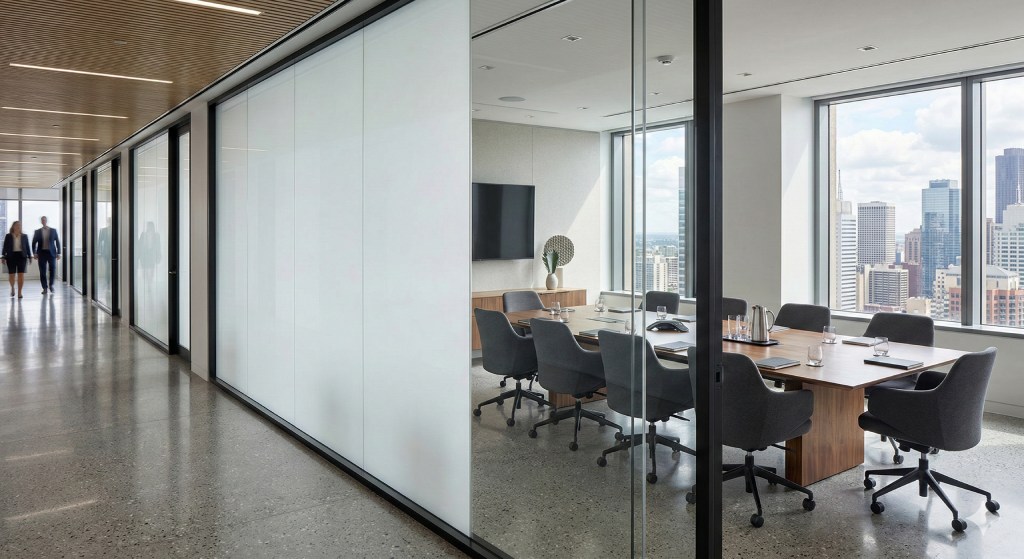
When upgrading office partitions or residential glazing, the cost of retrofitting smart film is often the primary deciding factor for UK property owners. If you are debating whether to replace windows or add smart film, understanding both the financial and practical implications is essential. Rather than tearing out perfectly good glass, applying a switchable Polymer Dispersed Liquid Crystal (PDLC) layer can transform your existing space into a dynamic, privacy-optimised environment.
As an experienced company offering premium quality products at competitive pricing, SmartPro Glass provides clear, factual guidance to help you navigate this exact decision. Below, we break down the true costs, technical specifications, and best use cases for both retrofitting and full window replacement.
Table of Contents
Quick Answer: Key Takeaways for Property Owners
- Cost Comparison: Retrofitting self-adhesive smart film starts at approximately £190 per square metre (m²), whereas laminated smart glass for new builds starts around £550 per square metre (m²).
- Lead Times: Smart film offers a rapid 10-working-day turnaround, compared to 30 working days for laminated glass.
- Best Use Cases: Film is ideal for existing indoor partitions and large retail or office areas. Laminated glass is required for wet areas like bathrooms or entirely new construction projects.
- Energy Efficiency: Both options block 99% of UV rays and roughly 40% of infrared light in the “off” state, potentially reducing energy bills by up to 30%.
- Visual Privacy: PDLC technology provides total visual privacy without being a blackout blind—diffused natural light still brightens the room.
Understanding PDLC Technology
Before diving into the numbers, it helps to know exactly what you are paying for. Switchable privacy glass and films operate using PDLC technology.
- The “Off” State: When unpowered, the liquid crystals are randomly scattered. This makes the glass completely opaque, offering total visual privacy while still allowing diffused light to pass through.
- The “On” State: When an electrical current is applied, the crystals align perfectly, turning the glass transparent.
We source premium PET, ITO powder, and adhesive layers to ensure a high-clarity product. While all PDLC products have a natural haze, our specifications guarantee a haze factor of under 3% and a total light transmittance of over 88% in the transparent state.
Retrofitting Smart Film: The Cheaper Alternative to New Windows
If your existing glass is in good structural condition, retrofitting self-adhesive smart film is undoubtedly a cheaper alternative to new windows.
The Financials and Logistics
Starting at around £190 per m², self-adhesive film is applied directly to your pre-installed glass. Because it bypasses the heavy manufacturing process of glass lamination, the lead time is remarkably fast—typically just 10 working days. It is also significantly easier and cheaper to transport to the site.
Ideal Applications
Retrofit film shines in environments where replacing the entire window system is difficult, disruptive, or prohibitively expensive.
- Corporate Offices & Meeting Rooms: Instantly switch from an open-plan feel to a private boardroom.
- Retail Spaces: Create dynamic storefronts (more on multimedia below).
- Large Surface Areas: Because the price per m² is much lower than that of laminated glass, covering expansive indoor areas becomes highly cost-effective.
Note: Smart film is strictly for indoor use and is not recommended for outdoor-facing applications or environments with high humidity.
Laminated Smart Glass: When to Replace Windows
Sometimes, applying a film isn’t the right engineering choice. If you are undertaking a new build or if the glass will be exposed to moisture, laminated smart glass is the necessary route.
The Financials and Logistics
Laminated smart glass consists of the PDLC layer securely sandwiched between two sheets of Extra Clear glass. This manufacturing process takes about 30 working days, and pricing starts at approximately £550 per m² (roughly 2.5 to 3 times the cost of retrofitting film).
Ideal Applications
- New Construction: Integrating the technology directly into the build phase.
- Wet Areas: Bathrooms, shower enclosures, and leisure centres. The lamination protects the PDLC layer from moisture, ensuring high durability.
Installation, Wiring, and Warranties
A frequent question we receive is regarding the smart film DIY cost. While purchasing the film outright and attempting a self-install might seem tempting, it is a high-risk approach. PDLC products require specialised handling.
SmartPro Glass offers comprehensive supply, site surveys, and installation services. Proper installation is critical for the lifespan of the product (which easily exceeds 10 years under normal usage).
The Silicone Warning
If there is one absolute rule in smart glass installation, it is this: You must use Neutral-Cure Silicone. Standard acetic-cure silicones (the ones that smell strongly of vinegar) will chemically destroy the PDLC layer. Having our installation team handle the fitting ensures the correct sealants are used, which is required to maintain your warranty.
Electrical Integration
Wiring switchable glass requires precision. Busbars must be professionally soldered and insulated, with wires discreetly hidden within glazing channels. Furthermore, if you want to connect your new privacy glass to a Smart Home or Building Management System (BMS), our installation team will coordinate directly with your BMS contractor to ensure seamless integration.
Shapes, Oversized, and Complex Dimensions
When budgeting for your project, it is vital to understand how pricing is calculated.
At SmartPro Glass, we operate on a straightforward pricing model. You are charged a fixed price based on the final panel size—we do not charge you for the raw sheet waste or offcuts. However, there are a few caveats:
- Minimum Order: Any panel smaller than 1 m² is charged as a full 1 m² unit.
- Complex Processing: While standard rectangular cuts follow our base pricing, complex shapes, bespoke cutouts, or oversized panels require specialised manufacturing and will attract higher costs.
Beyond Privacy: Energy Efficiency and Multimedia
Retrofitting smart film isn’t just an aesthetic upgrade; it carries tangible functional benefits.
Energy Savings In its opaque “off” state, the film blocks 99% of harmful UV rays, protecting your interior furnishings from fading. It also blocks roughly 40% of infrared heat. During the summer, this reduces the load on your air conditioning. In the winter, switching the glass “on” optimises natural light intake. Together, these thermal properties can reduce your overall energy consumption and utility bills by up to 30%.
Interactive Capabilities For commercial spaces, the opaque state of the film doubles as a high-definition rear-projection screen. When combined with infrared touch frames, your office partition or retail window can be transformed into an interactive, touch-sensitive multimedia display.
Frequently Asked Questions (FAQs)
Is It Better to Replace Windows or Add Smart Film?
If your current glass is indoors, structurally sound, and not in a wet environment (like a bathroom), adding smart film is the most cost-effective and efficient choice. If you are building from scratch or fitting a shower screen, you must use laminated smart glass.
What is the True Smart film DIY Cost?
While the raw material cost of the film might seem lower, DIY installations carry a massive risk of bubbling, electrical failure, or chemical damage from using the wrong sealants (like acetic silicone). Professional installation by a team like SmartPro Glass ensures correct busbar soldering, hidden wiring, and a validated warranty.
How Long Does Smart Film Last?
Under normal usage and with professional installation, the lifespan of our smart film and smart glass exceeds 10 years.
Does the Glass Go Completely Dark?
No. PDLC technology provides absolute visual privacy, meaning no one can see through it, but it is not a blackout blind. It diffuses light, meaning your room will still benefit from natural daylight even when the glass is opaque.