

Smart Film For Office Partitions: An Alternative to Blinds

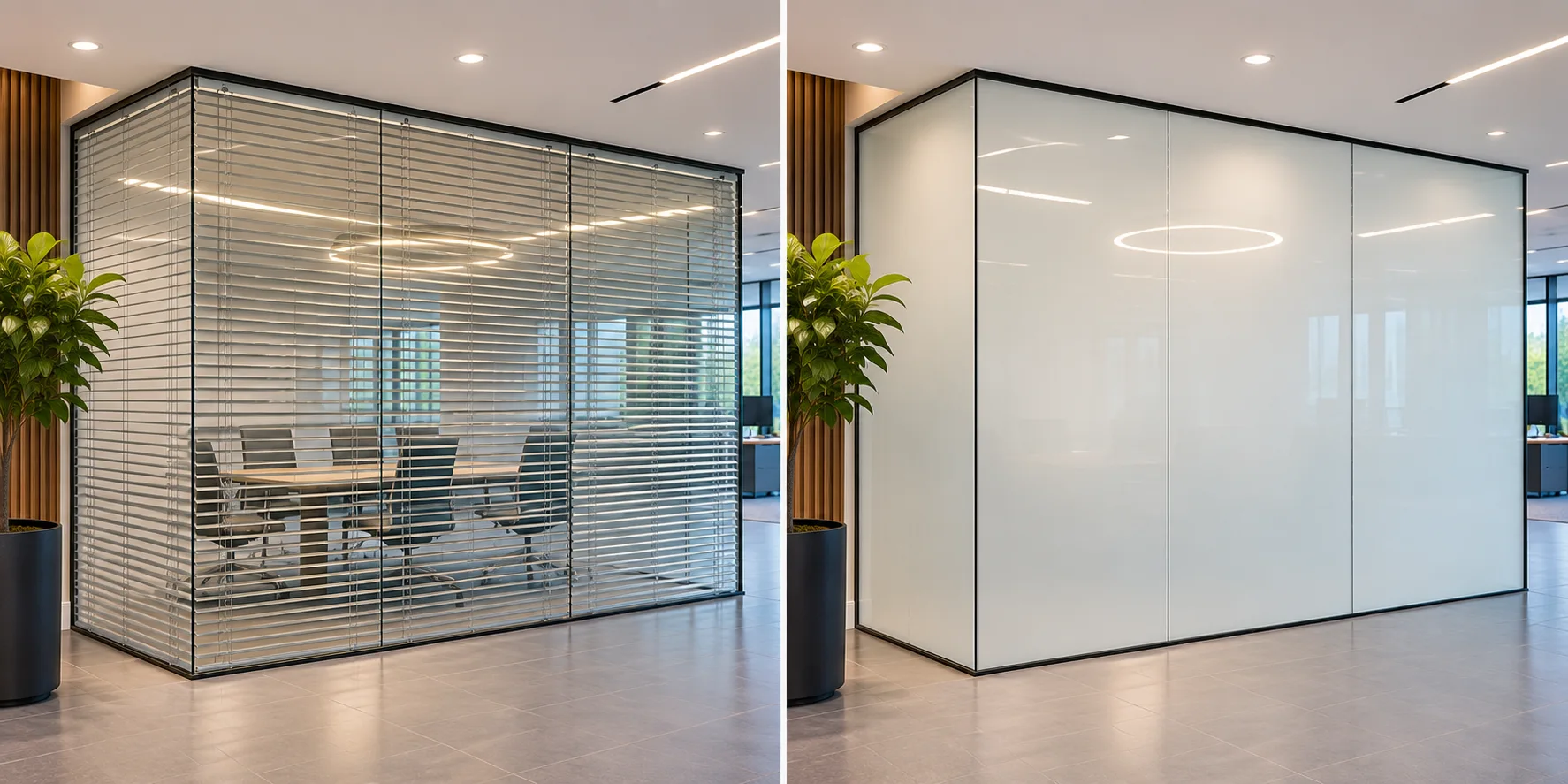
Smart film for office partitions offers a modern way to introduce privacy into meeting rooms and offices without compromising the clean appearance of frameless glazing. As businesses increasingly use glass to create open, light-filled workspaces, the need for flexible privacy has become an important part of office design.
Traditional blinds can provide privacy, but they often introduce additional hardware, visual clutter and maintenance requirements to otherwise minimalist glass partitions. Switchable smart film provides a different approach, allowing glass to change from transparent to opaque at the touch of a button while maintaining the appearance of the original partition when privacy is not required.
Why Are Blinds Becoming Less Suitable for Modern Glass Offices?
Frameless glass partitions are designed to create a clean, uninterrupted appearance, allowing natural light to travel through the workplace while maintaining visual connections between different areas. Adding blinds can sometimes compromise this design, particularly when tracks, brackets, cords or mechanisms become visible across the glass.
Blinds can also require regular cleaning and maintenance, as dust may accumulate on slats or fabric, and mechanical components can become damaged through frequent use. In busy offices where meeting rooms are used throughout the day, these practical considerations can affect both appearance and usability.
For businesses that want to retain the minimalist look of glass while introducing privacy only when necessary, smart film offers an alternative that is integrated directly into the glazing.
What Is Smart Film for Office Partitions?
Smart film is an electrically switchable film that can be applied to suitable existing glass surfaces. Using PDLC (Polymer Dispersed Liquid Crystal) technology, it changes its optical appearance when electrical power is applied or removed.
When the film is switched OFF, it becomes opaque or frosted, obscuring visibility through the glass and providing visual privacy. When switched ON, it becomes transparent, allowing the meeting room or office to remain visually connected to the surrounding workspace.
This allows businesses to control privacy using a wall switch, remote control or compatible automation system. Unlike blinds, smart film does not need to be opened, closed, raised or lowered, and it does not introduce an additional covering to the glass partition.
Explore SmartPro Glass’s self-adhesive smart film for retrofit projects or switchable smart glass for new glazing installations.
Smart Film vs Blinds: Which Is Better for Office Partitions?
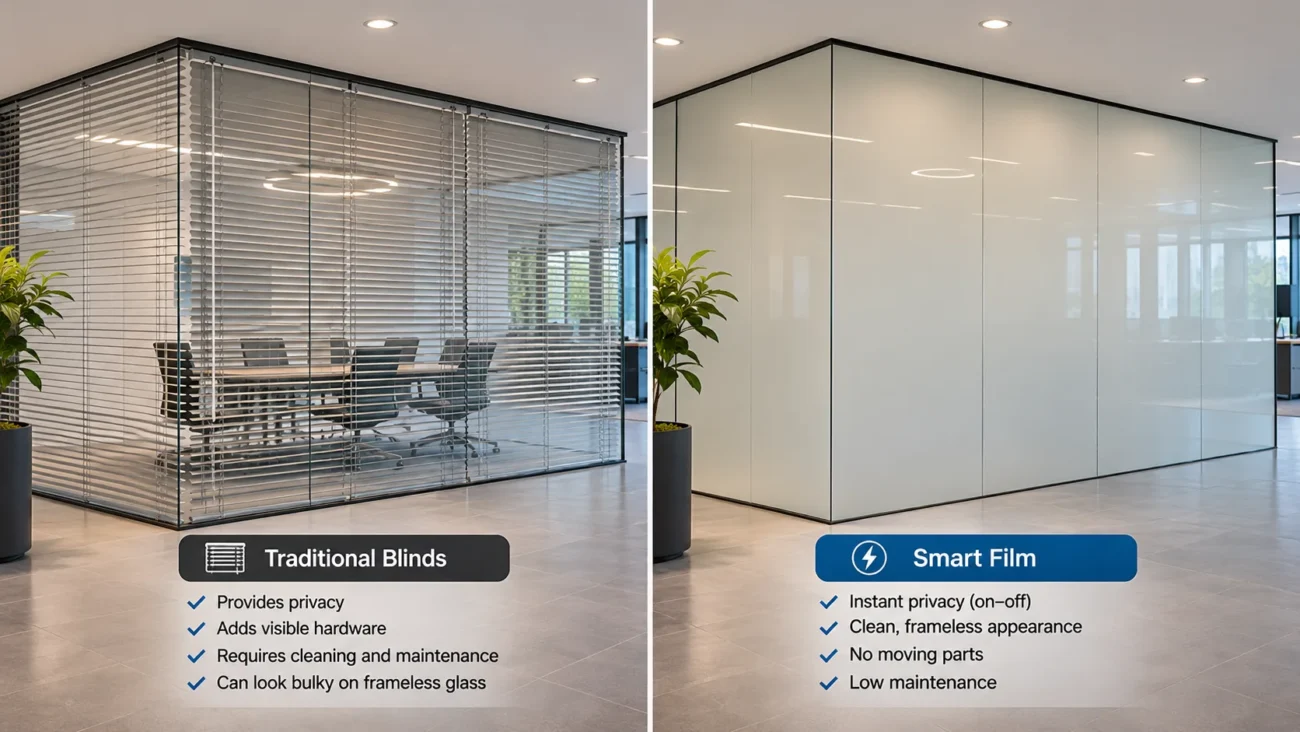
Both smart film and blinds can provide privacy, but they work differently and are suited to different requirements. Blinds physically cover the glass, while smart film changes the appearance of the glazing itself.
| Feature | Traditional Blinds | Smart Film |
|---|---|---|
| Appearance | Additional covering and hardware | Clean glass appearance |
| Privacy control | Manual or motorised movement | Electrical switching |
| Frameless partitions | May require brackets, tracks or fittings | Applied directly to suitable glass |
| Moving parts | Mechanical components may be present | No moving mechanical components within the film |
| Maintenance | Slats, fabric, tracks and mechanisms require cleaning or maintenance | Smooth glass surface can be cleaned appropriately |
| Daylight | Can significantly block light when closed | Diffuses light in the opaque state |
| Privacy | Depends on blind design and coverage | Uniform frosted appearance across treated area |
| Open state | Blinds remain physically visible | Glass returns to transparent appearance |
| Design | Can introduce visual clutter | Maintains minimalist glass design |
Smart film is particularly suitable where visual appearance is important and privacy needs to be activated only occasionally. Blinds may still be the better option where blackout conditions, adjustable shading or precise sunlight control are required.
Why Smart Film Is Ideal for Frameless Glass Partitions
Frameless partitions are often selected to create a contemporary office environment with minimal visual interruption. Because smart film is applied directly to the glass, it can preserve the architectural appearance of these partitions without requiring a separate window covering.
When the glass is transparent, the office retains its open appearance and visual connection between spaces. When privacy is required, the film switches to its opaque state, allowing meeting rooms and individual offices to become private without changing the physical layout of the workspace.
Smart film can also be specified for selected glass panels rather than every partition in the office. This gives businesses flexibility to introduce privacy where it is most needed, such as meeting rooms, executive offices, consultation areas or rooms used for confidential discussions.
Smart Film for Meeting Rooms and Boardrooms
Meeting rooms are one of the most practical applications for smart film. Frameless glass meeting rooms can look attractive and spacious when they are not in use, but they may require privacy during client meetings, presentations, confidential discussions or internal planning sessions.
With smart film, the room can remain transparent during normal office use and switch to opaque when a meeting begins. This avoids the need for employees to operate blinds manually and provides a consistent privacy appearance across the glass.
The technology can also be integrated with different control arrangements, allowing individual rooms or selected glass panels to be controlled separately. Depending on the project requirements, controls can be positioned conveniently near the entrance or integrated into a wider smart building system.
Can Smart Film Be Installed on Existing Frameless Partitions?
Yes. Self-adhesive smart film is designed for retrofit applications and can be installed on many suitable existing glass partitions. This means businesses may be able to upgrade their privacy without removing and replacing the existing glass.
The film is manufactured to the required dimensions and applied directly to the glass surface. Electrical connections are made through the film’s busbars, with the wiring route planned to suit the partition design and available space.
Frameless partitions require particular attention to cable routing and the positioning of electrical connections to maintain a clean finish. Before installation, the glass dimensions, wiring arrangement, busbar location and edge-sealing requirements should be carefully considered.
You can read more about smart film installation and installing smart glass on existing windows.
Does Smart Film Block All Light?
Smart film is designed primarily to provide visual privacy, not blackout. In its opaque state, it obscures the view through the glass while allowing light to pass through in a diffused form.
This can be advantageous in offices where privacy is required without making meeting rooms feel completely dark. However, people and objects behind the glass may still be visible as indistinct shapes depending on the film specification, lighting conditions and viewing angle.
If a space requires complete darkness for presentations, projection or specialist applications, blackout blinds or an additional shading solution may still be necessary. Smart film should therefore be selected based on the privacy requirements of the space rather than assuming it will replace every function of traditional blinds.
Smart Film and Natural Light in Modern Offices
One of the key advantages of glass partitions is their ability to help distribute natural light through the workplace. Conventional blinds can reduce this benefit when closed, particularly where large areas of glass are covered.
Smart film changes the glass to a frosted appearance rather than creating a solid physical barrier. This allows diffused light to continue passing through the partition, although the actual amount depends on the product specification and surrounding lighting conditions.
Maintaining a balance between privacy, natural light and workplace comfort is an important consideration in office design. The UK Health and Safety Executive provides further guidance on lighting and workplace human factors.
Is Smart Film More Expensive Than Blinds?
The initial cost of smart film is generally higher than basic manual blinds because the system includes the switchable film, electrical components and control arrangements. However, for premium office interiors, the comparison should consider the complete solution rather than only the initial purchase price.
Smart film provides an integrated privacy solution while maintaining the appearance of the glass. It eliminates the need for a separate covering and can be particularly attractive where the design places significant emphasis on frameless glazing and minimalist interiors.
The total project cost depends on the glass area, number of panels, film specification, electrical arrangement, controls and whether installation is required. For larger projects, these details should be assessed together to establish the most suitable solution.
A Practical Example: A Modern UK Office
Imagine a modern office in London with several frameless glass meeting rooms surrounding an open-plan workspace. The business wants to retain transparency throughout the day but needs privacy for client meetings, management discussions and confidential presentations.
Traditional blinds could provide privacy, but they would introduce additional hardware and affect the clean appearance of the glass partitions. Smart film allows each selected meeting room to remain transparent when not in use and become opaque when privacy is required.
This is an illustrative scenario rather than a specific customer installation, but it demonstrates how smart film can support modern office design while providing flexible privacy. The same approach can be used in boardrooms, executive offices, consultation rooms and other spaces where privacy needs change throughout the day.
When Should You Choose Smart Film Instead of Blinds?
Smart film is particularly suitable for offices where the primary requirement is visual privacy and maintaining a clean, modern glass appearance. It works well on frameless partitions, meeting rooms, boardrooms and internal glazed offices where transparency is desirable for most of the day.
Blinds may still be preferable where the project requires complete blackout, adjustable shading or direct control over sunlight. In some environments, smart film and other shading systems may even be used together to address different requirements.
The best solution depends on the purpose of the glazing, the desired appearance, privacy requirements, lighting conditions and budget. For businesses upgrading existing partitions, self-adhesive smart film offers a way to introduce switchable privacy without replacing the glass.
Frequently Asked Questions
1. Can smart film replace blinds on office partitions?
Yes. Smart film can replace blinds when the main requirement is visual privacy. It allows glass to switch between transparent and opaque states without additional window coverings.
2. Is smart film suitable for frameless glass partitions?
Yes. Self-adhesive smart film can be applied to many suitable existing frameless glass partitions, provided the electrical connections and installation details are properly planned.
3. Does smart film provide complete privacy?
It provides visual privacy by making the glass opaque or frosted. The precise level of concealment depends on the film specification and lighting conditions, so samples should be tested in the intended environment.
4. Does smart film block natural light?
No, not completely. In its opaque state, PDLC smart film diffuses light rather than creating a blackout barrier, allowing some natural illumination to pass through.
5. Can individual meeting rooms have separate smart film controls?
Yes. The electrical design can allow individual rooms, panels or groups of panels to be controlled separately, depending on the project requirements.
6. Is smart film better than blinds for modern offices?
Smart film is often better suited to offices where maintaining a clean glass appearance and providing privacy on demand are priorities. Blinds may remain more suitable for blackout or adjustable shading requirements.
Conclusion
Smart film for office partitions offers a modern alternative to traditional blinds, particularly in offices with frameless glass meeting rooms and minimalist interiors. By allowing glass to switch between transparent and opaque states, it provides privacy on demand without introducing additional coverings or mechanical systems.
For businesses that want to maintain the open, light-filled appearance of glass while creating private spaces when needed, smart film is a practical and visually integrated solution. It combines flexibility, contemporary design and convenient privacy control, making it an increasingly relevant option for modern commercial interiors.
To explore SmartPro Glass solutions, visit our office applications page or contact our team to discuss your project.